The MOLLUSCA Project
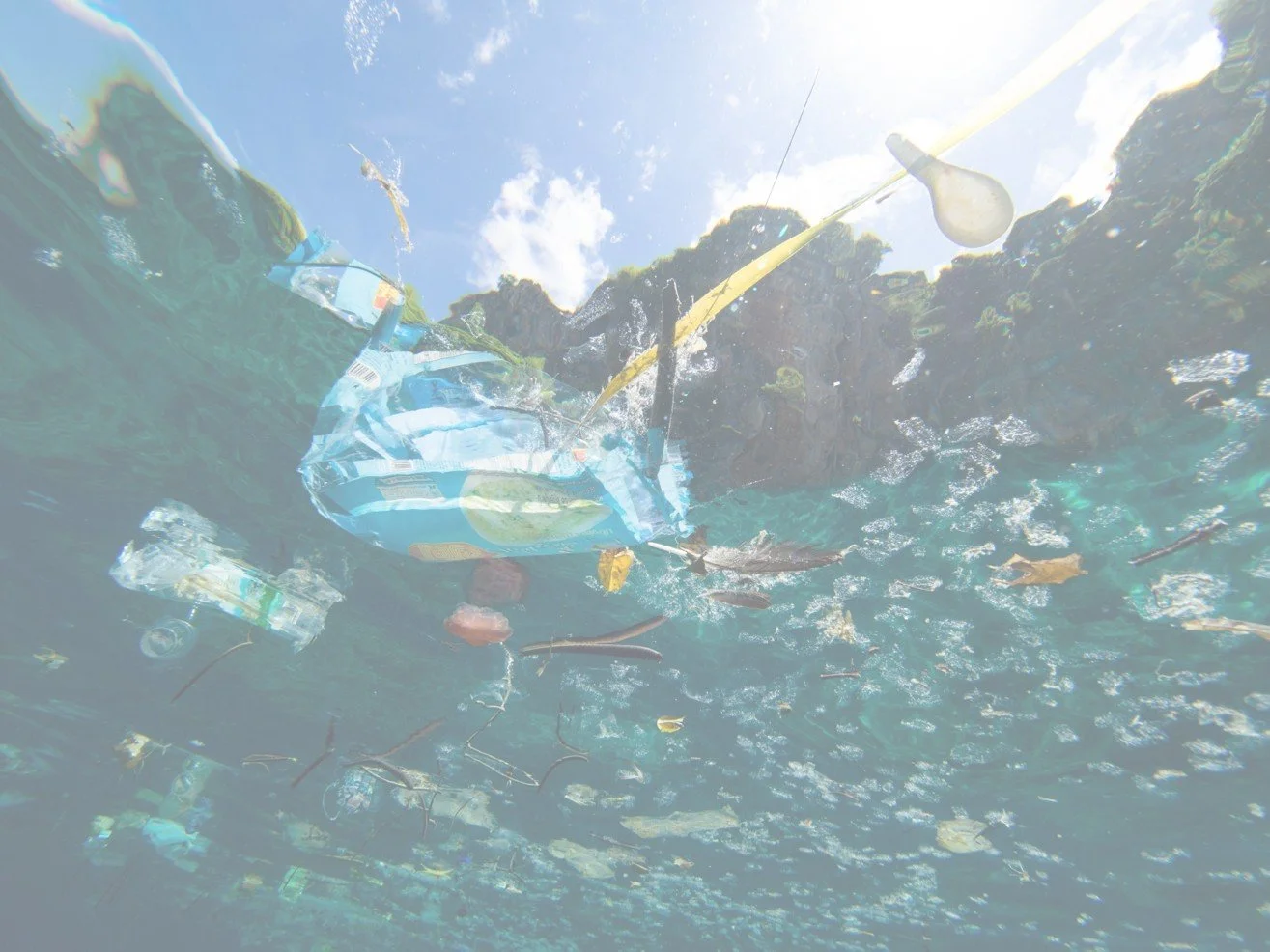
An estimated 171 trillion plastic particles are currently floating in the world's oceans. The goal of this project was to find an effective way to collect and remove them. Conventional net-based collection can disturb the water surface, mixing floating plastic particles into the bulk water while capturing large amounts of organic material. As part of MOLLUSCA, our research group developed a robot modeled after the apple snail, which feeds by undulating its foot to generate surface flows that transport suspended particles. The robot uses a 3D-printed undulating "carpet" to pump at the liquid-air interface, drawing microplastics toward a collection unit without disturbing the water beneath it.
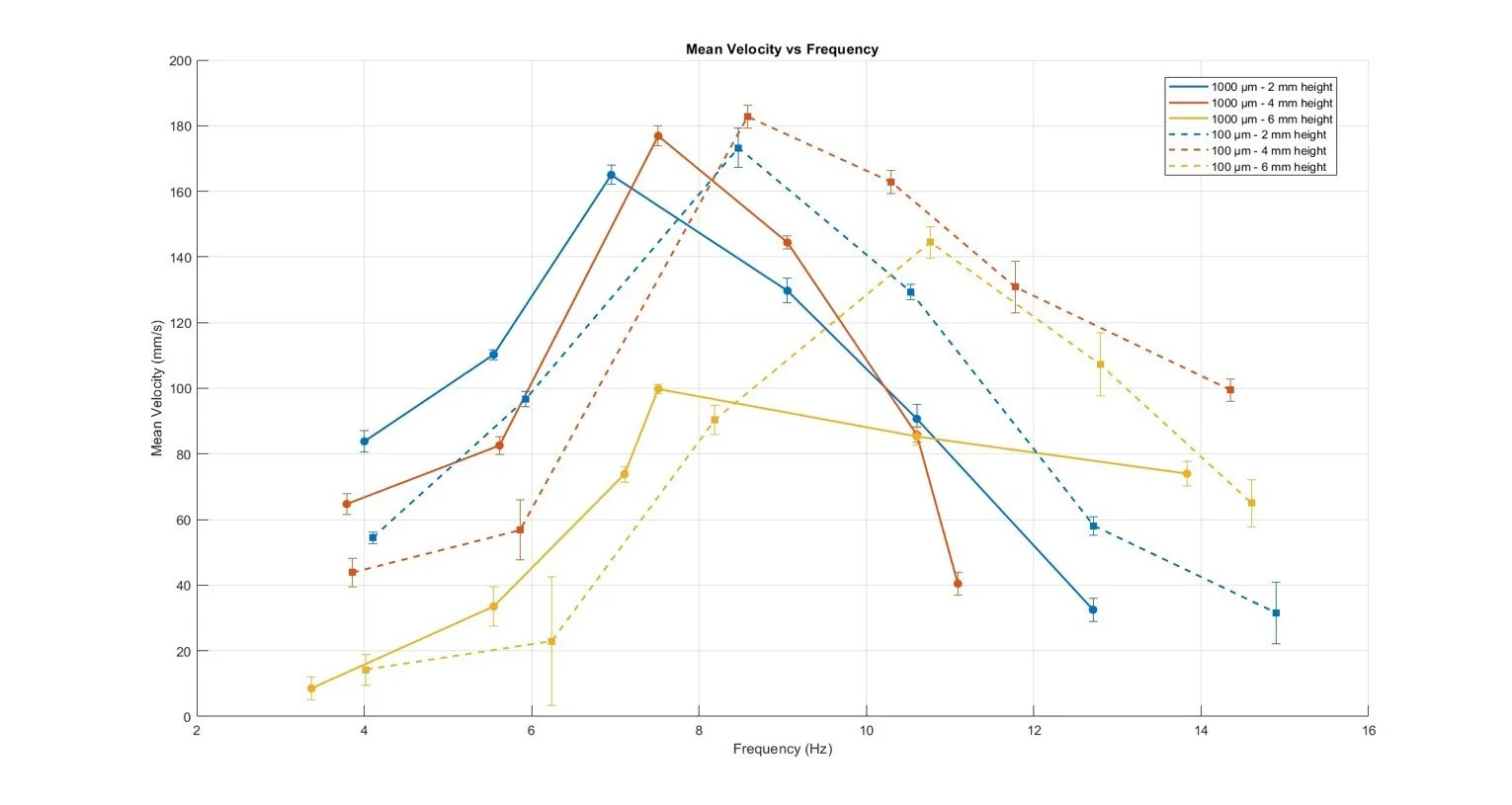
My role in this project was to characterize the undulating mechanism and determine how its operating parameters affected pumping performance. I refined the experimental design, modeled and built the test apparatus in SolidWorks, and analyzed video recordings of the resulting flow. These experiments revealed that pumping performance peaks at an optimal driving frequency and that this optimum shifts with particle size and water depth. These results allowed optimization and tuning of the full-scale robot.





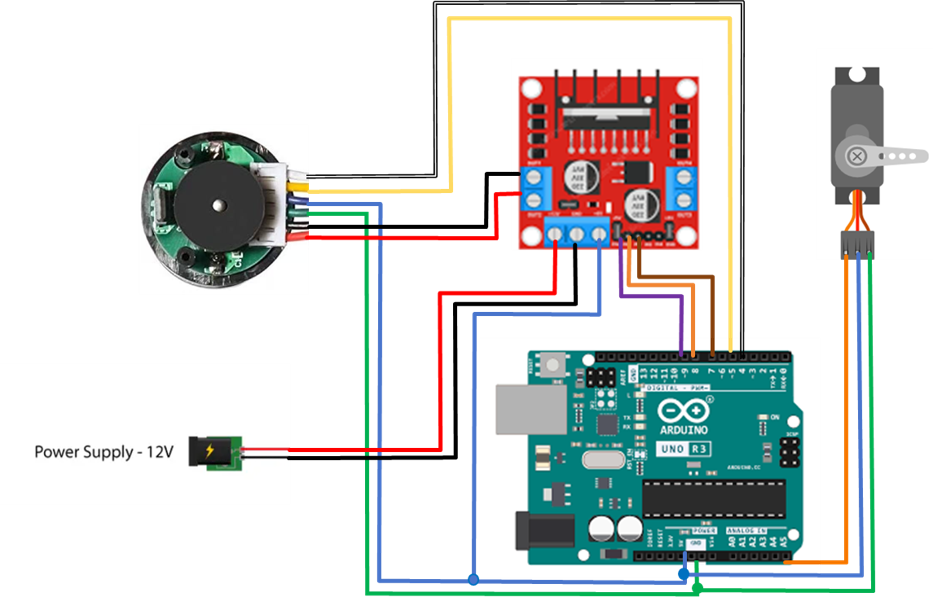
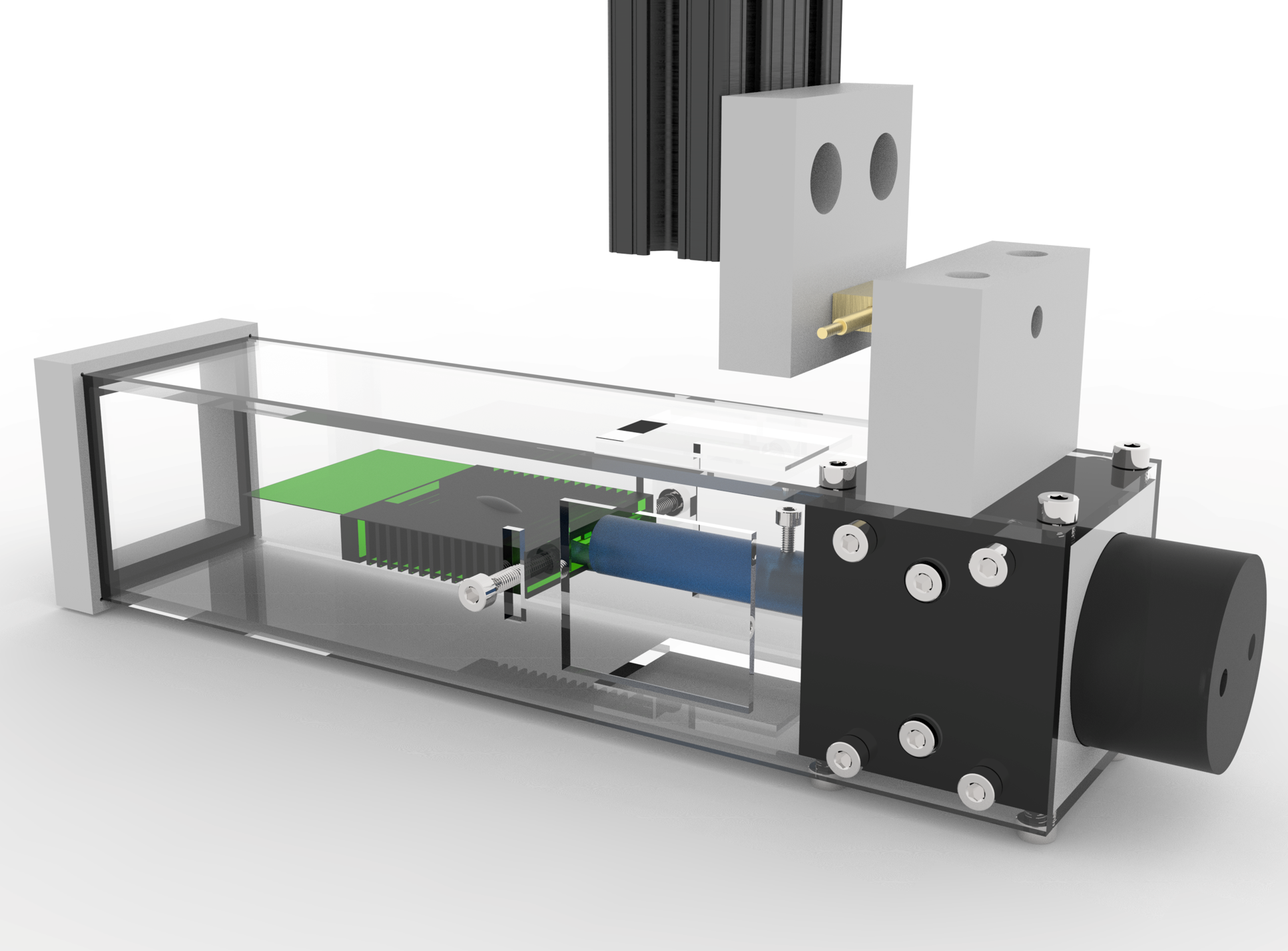
I built the test apparatus used to characterize the undulator. I modeled the rig in SolidWorks and fabricated the parts through 3D printing and machining (Mill/Lathe). The design has an undulating carpet driven by a rotating helix on a 12V DC motor, mounted inside a clear-walled water tank alongside a force sensor and a high-speed scientific camera to image particle motion at the surface. I wired and programmed the motor driver and sensors through Arduino so we could sweep driving frequencies and log data repeatably. Getting clean measurements took many iterations because motor vibration shook the whole tank and blurred the images. Stray room light washed out the particles against the background, so I redesigned the mounting to isolate the motor from the tank frame and built an enclosure with controlled backlighting to keep the optical setup consistent between runs.
The Test Apparatus
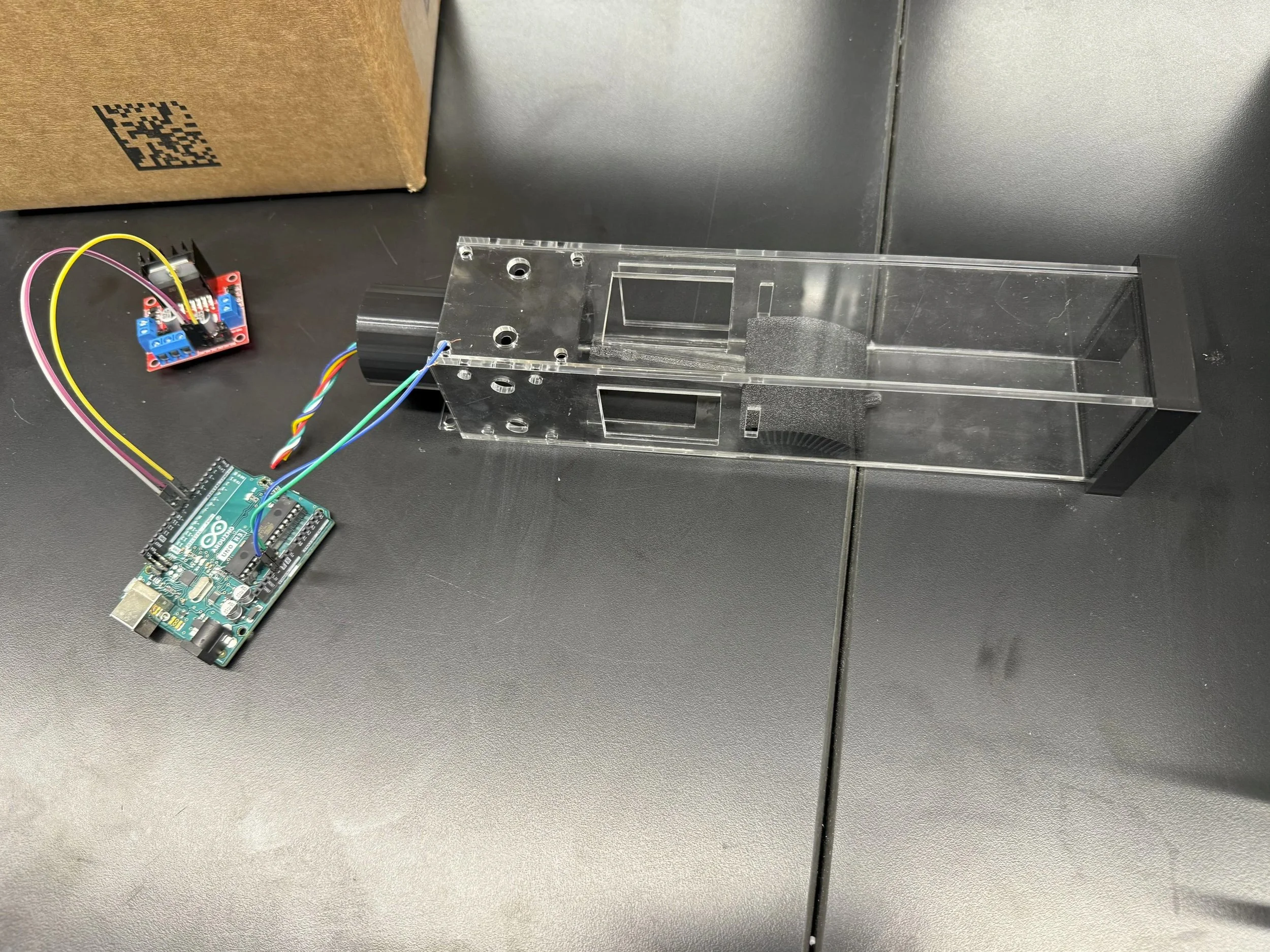
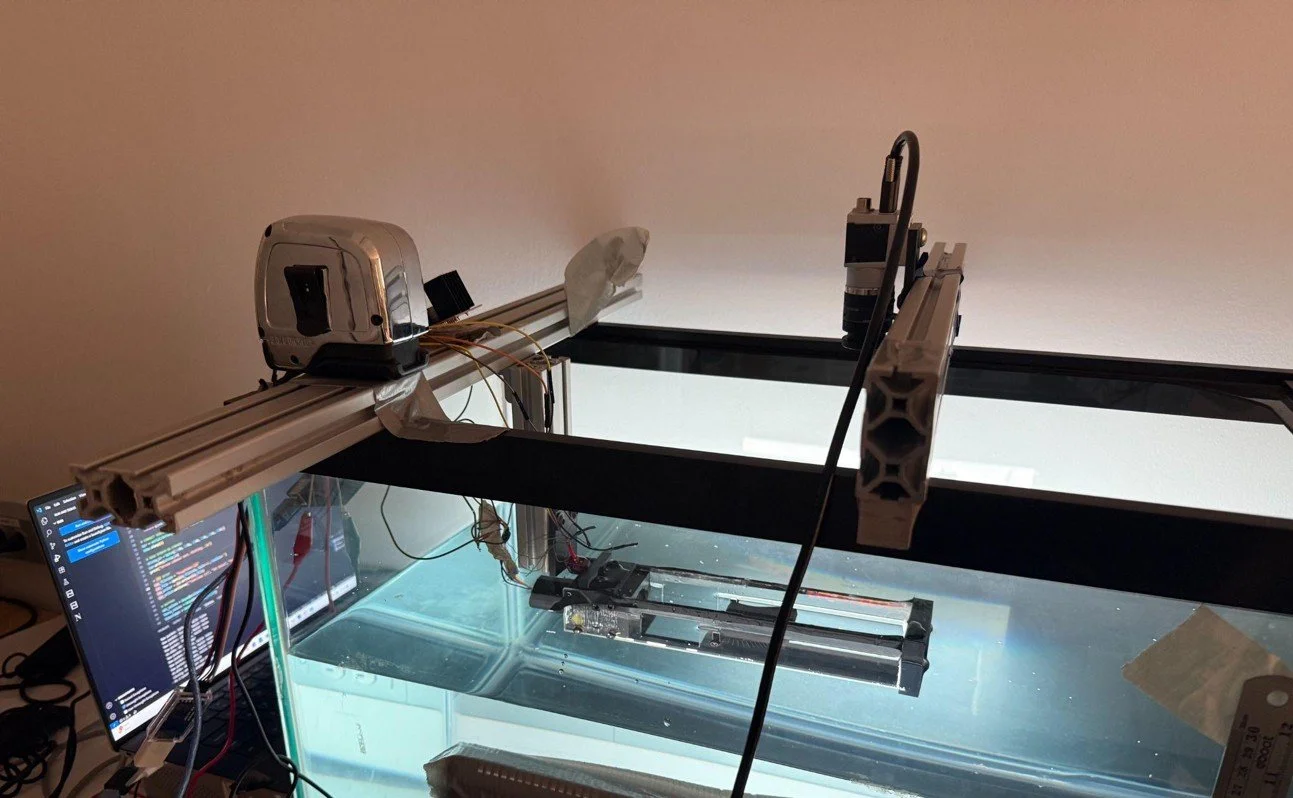
To measure undulator quality and performance, I added microplastic particles of known sizes to the tank. To numerically quantify the flow, I tracked how the particles moved across the undulator. I used particle tracking software in MATLAB that follows individual particles frame by frame as they move across the water surface. I repeated the test across a range of parameters, such as driving frequency, particle size, and depth below the surface. Reflections and uneven lighting created false detections, and particles occasionally overlapped or dropped out of frame. Therefore, I added filtering and gap-handling logic to keep trajectories from breaking or jumping between neighboring particles.
Testing
I measured mean surface particle velocity across driving frequencies from roughly 3 to 15 Hz, for two particle sizes (100 µm and 1000 µm) at three water heights above the undulator (2, 4, and 6 mm). Every configuration followed the same shape, and velocity climbed with frequency to a local maximum near 7--11 Hz, peaking around 180 mm/s, then fell off. This shows that there is an optimal frequency and faster undulation is not always better. The peak mean velocity shifted with variables, such as particle size and water height, demonstrating that the full-scale robot needs to be tuned to the particle size and depth it is targeting rather than run at a single fixed frequency.
Result